

Marcil Hall
A display case on the lower level of Marcil Hall on the UNE Biddeford Campus highlights materials from the collections and displays student work from related classes.
See these exhibits whenever the building is open to the public. Some of our past exhibits are documented in DUNE:DigitalUNE.
Current Exhibit
What Her Diary Reveals: Daily Narratives and Untold History
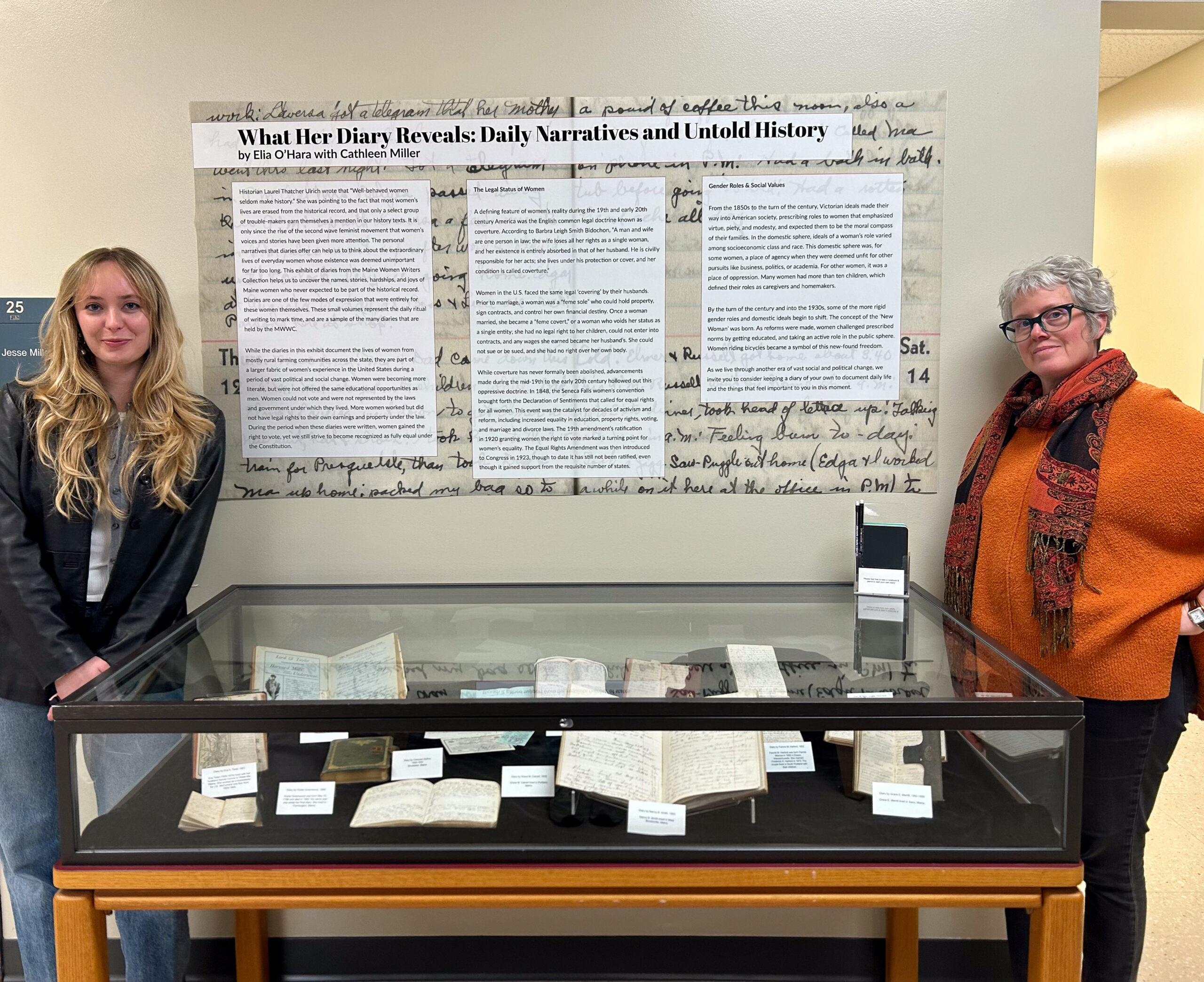
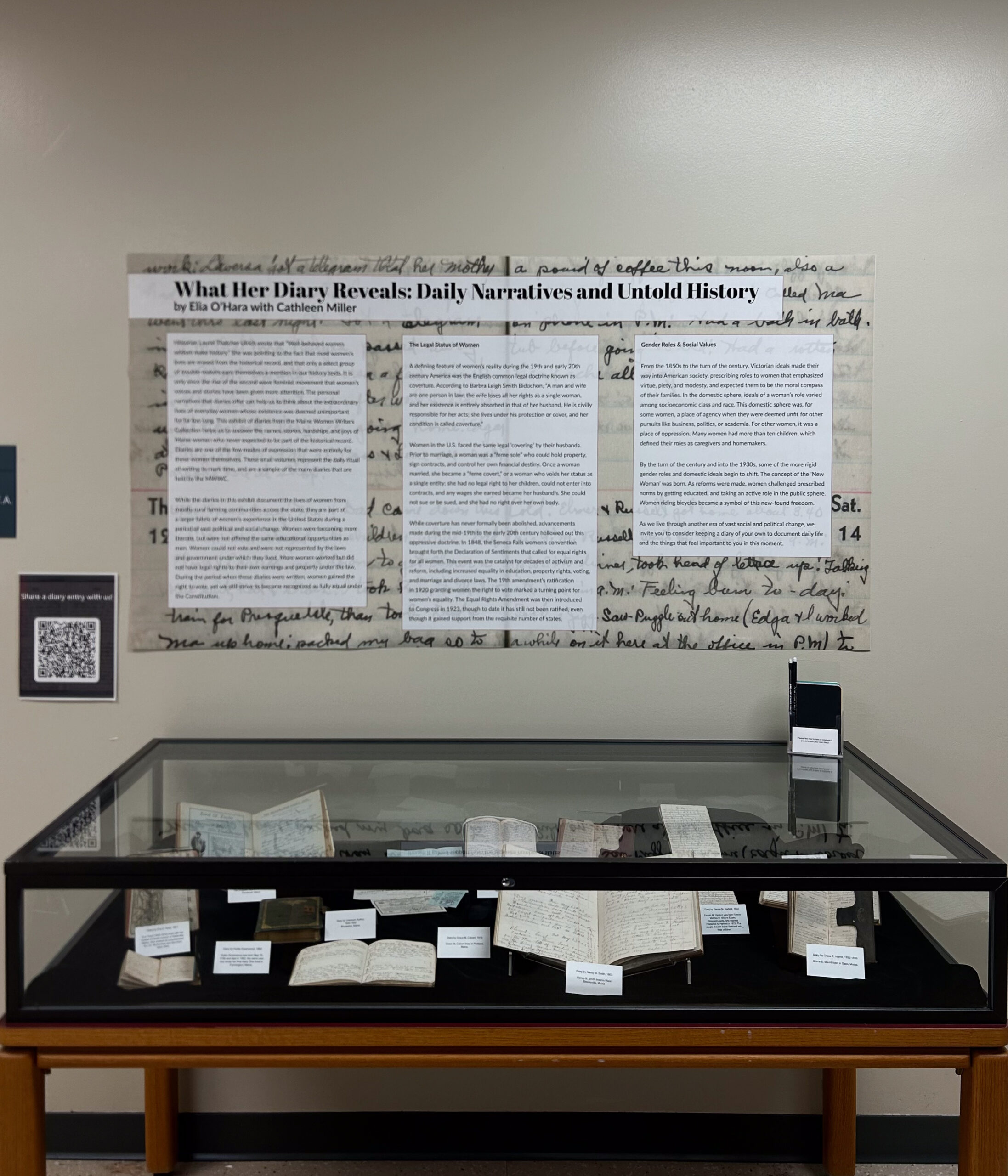

“What Her Diary Reveals: Daily Narratives and Untold History” is the new exhibit in the MWWC’s display case in Marcil Hall on the Biddeford Campus, created by Elia O’Hara (English and Political Science double major ’25) in collaboration with Education and Outreach Archivist Cathleen Miller.
The exhibit includes diaries from the MWWC’s holdings from the mid-1800s to the early 1930s. It demonstrates how everyday Maine women have documented their personal histories and, in doing so, preserved their part in the historical record.
Complementing the exhibit, Elia and fellow student Sarah Dill (Political Science ’25) co-wrote an op-ed about the exhibit, “Struggling with the News Cycle? Start Keeping a Diary,” that appeared in the Portland Press Herald on April 24, along with an April 15 article titled “Diaries for Democracy: How Keeping a Diary Holds More Power Than You Might Think” in UNE’s student newspaper, the Bolt.
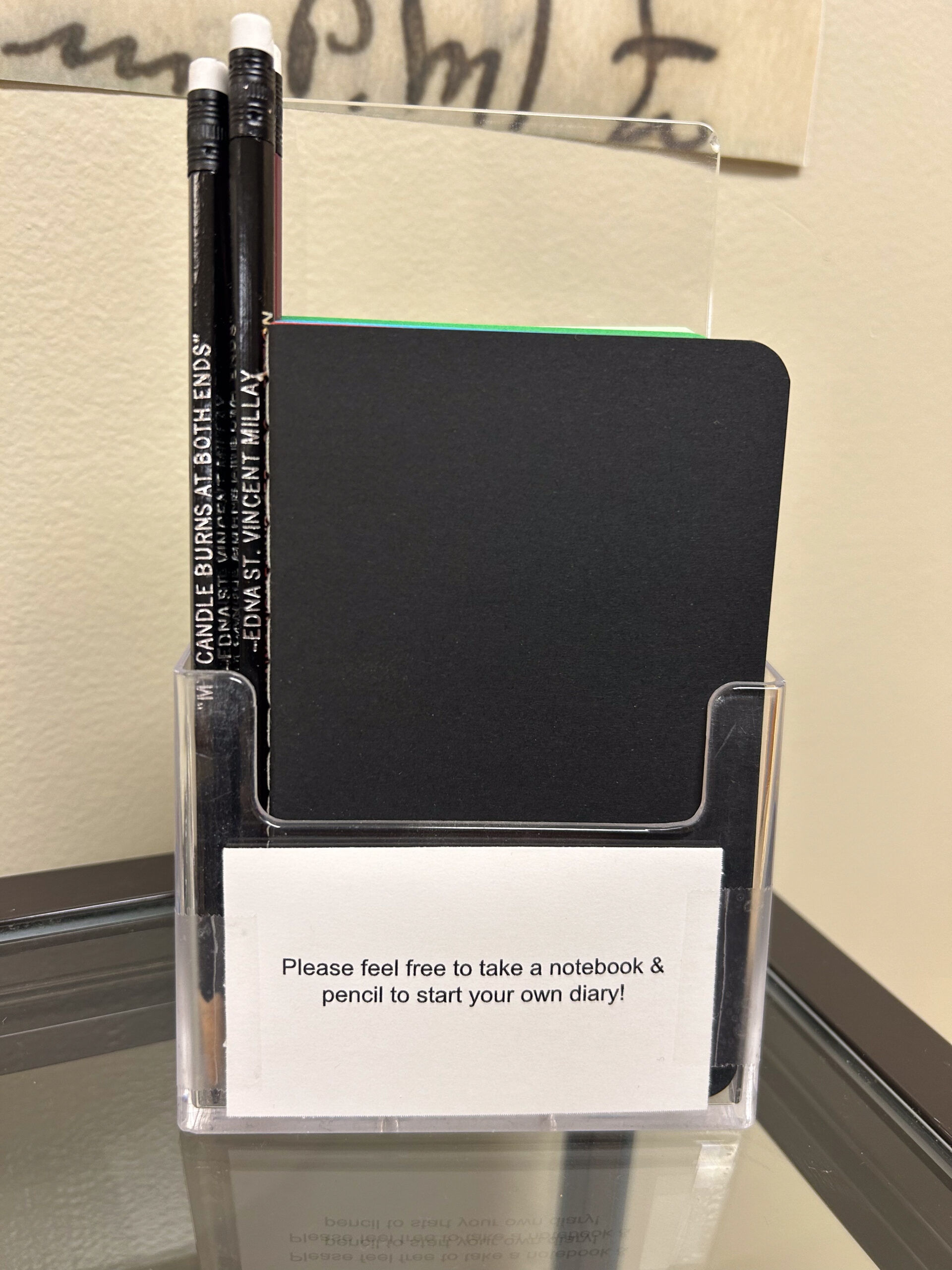
Join in by submitting your own diary entry!
Exhibit Text
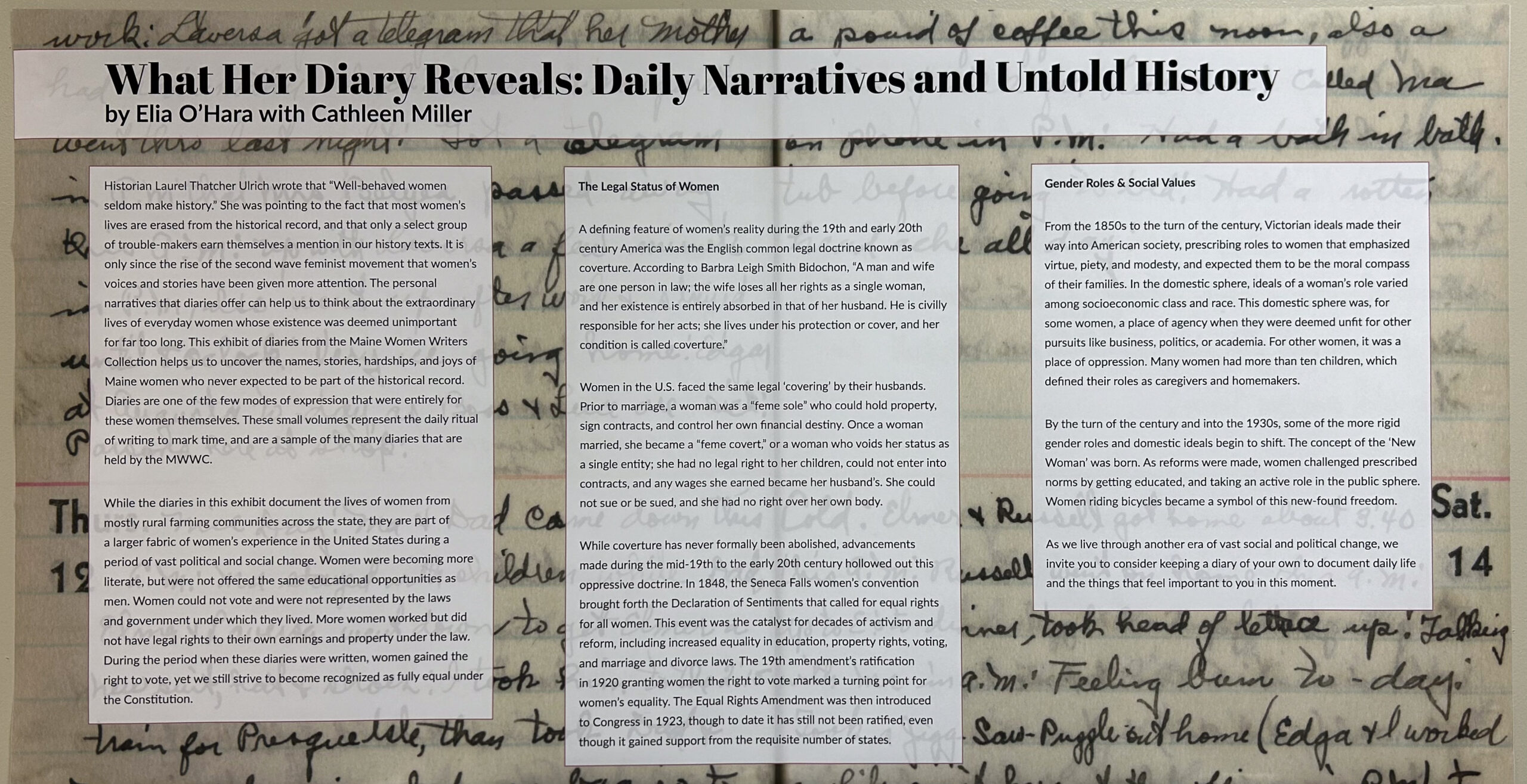
What Her Diary Reveals: Daily Narratives and Untold History
by Elia O’Hara with Cathleen Miller
Historian Laurel Thatcher Ulrich wrote that “Well-behaved women seldom make history.” She was pointing to the fact that most women’s lives are erased from the historical record, and that only a select group of trouble-makers earn themselves a mention in our history texts. It is only since the rise of the second wave feminist movement that women’s voices and stories have been given more attention. The personal narratives that diaries offer can help us to think about the extraordinary lives of everyday women whose existence was deemed unimportant for far too long. This exhibit of diaries from the Maine Women Writers Collection helps us to uncover the names, stories, hardships, and joys of Maine women who never expected to be part of the historical record. Diaries are one of the few modes of expression that were entirely for these women themselves. These small volumes represent the daily ritual of writing to mark time, and are a sample of the many diaries that are held by the MWWC.
While the diaries in this exhibit document the lives of women from mostly rural farming communities across the state, they are part of a larger fabric of women’s experience in the United States during a period of vast political and social change. Women were becoming more literate, but were not offered the same educational opportunities as men. Women could not vote and were not represented by the laws and government under which they lived. More women worked but did not have legal rights to their own earnings and property under the law. During the period when these diaries were written, women gained the right to vote, yet we still strive to become recognized as fully equal under the Constitution.
The Legal Status of Women
A defining feature of women’s reality during the 19th and early 20th century America was the English common legal doctrine known as coverture. According to Barbra Leigh Smith Bidochon, “A man and wife are one person in law; the wife loses all her rights as a single woman, and her existence is entirely absorbed in that of her husband. He is civilly responsible for her acts; she lives under his protection or cover, and her condition is called coverture.”
Women in the U.S. faced the same legal ‘covering’ by their husbands. Prior to marriage, a woman was a “feme sole” who could hold property, sign contracts, and control her own financial destiny. Once a woman married, she became a “feme covert,” or a woman who voids her status as a single entity; she had no legal right to her children, could not enter into contracts, and any wages she earned became her husband’s. She could not sue or be sued, and she had no right over her own body.
While coverture has never formally been abolished, advancements made during the mid-19th to the early 20th century hollowed out this oppressive doctrine. In 1848, the Seneca Falls women’s convention brought forth the Declaration of Sentiments that called for equal rights for all women. This event was the catalyst for decades of activism and reform, including increased equality in education, property rights, voting, and marriage and divorce laws. The 19th amendment’s ratification in 1920 granting women the right to vote marked a turning point for women’s equality. The Equal Rights Amendment was then introduced to Congress in 1923, though to date it has still not been ratified, even though it gained support from the requisite number of states.
Gender Roles & Social Values
From the 1850s to the turn of the century, Victorian ideals made their way into American society, prescribing roles to women that emphasized virtue, piety, and modesty, and expected them to be the moral compass of their families. In the domestic sphere, ideals of a woman’s role varied among socioeconomic class and race. This domestic sphere was, for some women, a place of agency when they were deemed unfit for other pursuits like business, politics, or academia. For other women, it was a place of oppression. Many women had more than ten children, which defined their roles as caregivers and homemakers.
By the turn of the century and into the 1930s, some of the more rigid gender roles and domestic ideals begin to shift. The concept of the ‘New Woman’ was born. As reforms were made, women challenged prescribed norms by getting educated, and taking an active role in the public sphere. Women riding bicycles became a symbol of this new-found freedom.
As we live through another era of vast social and political change, we invite you to consider keeping a diary of your own to document daily life and the things that feel important to you in this moment.